
Tuesday, May 22, 2012
Hiatus
Thank you to the few parents that have supported this blog. Currently I am taking time away from blogging about the works created by our talented students and am focusing on ways that this blog can become more productive as an interactive communication tool. The statistics so far have shown that only parents that are directly emailed have viewed the post related to their child's work and there has been a few international audiences. It is my aim to make this blog reach a target audience of the WHOLE school, including staff and for the number of post comments and members to increase. The blog will resume in Term 3 with a renewed outlook and energy. Until then, if you are a regular reader please feel free to promote the existence of this blog. Let's celebrate the achievements of our young artists as a community.

Thursday, March 29, 2012
Matisse, Merello and Still Life
Year 4 have been prolific with their artwork. They began the term by painting self portraits that represented a word beginning with their first name, such as Silly Sam and Amazing Amber. They then turned their skills to drawing from observations and painting in watercolours. Finally they combined their skills and knowledge to produce some self portraits influenced by the drawings of Matisse and the colourful works of contemporary Spanish artist Merello. The following are the artworks we viewed and discussed.


Click on this link to view the complete flipbook of their portraits http://snack.to/fu30vs5p
Click on this link to view the complete flipbook of their still life watercolour http://snack.to/fznsof3c
Below is a sneak preview only.
Friday, March 23, 2012
Still Life With a Skull
 |
| STILL LIFE WITH A STEER’S SKULL, Pablo Picasso, April 5, 1942 |
 |
Still Life with Bull's Skull (Bulls Skull, Fruit, Pitcher), Pablo Picasso, 1939 Oil on canvas |
This term Year 5 students were introduced to Picasso's Cubism works and they learnt a few interesting facts about him, such as having a super long name due to Spanish naming customs. Pablo Picasso was one of the greatest and most influential artists of the 20th century. His painting style changed many times throughout his career, and he produced a range of images, from classical figures to radical abstractions. The Cubism art movement is a semi-abstract style that tries to express the artist's sense of structure by arranging on his canvas the geometrical elements of shapes from objects in reality. Basically this means that the artist wanted to break down the image to a more simplified and basic shape with strong lineal/geometric representation. Year 5 were challenged to respond to Picasso's works by also attempting to draw their still life not as they saw it, but to break it down to geometric shapes or more simplified, while ensuring that their audience would still be able to identify what the still life objects were in real life. They also explored how Picasso painted directly onto the canvas, mixing and blending in varied strokes and they also experimented with this technique in their own style using paint and oil pastels. They then developed their work further by adding collage. This work is still in progress and almost completed. Below are some images of completed works from the first stage. Please follow this link to view the works in full http://snack.to/fztj2phv
Please note: Below is a preview and not the entire Flip book. You must click on the above link to view the flip book in its entirety from the Sharesnack website.
Please note: Below is a preview and not the entire Flip book. You must click on the above link to view the flip book in its entirety from the Sharesnack website.
Thursday, March 22, 2012
Treachery of Sanctuary by Chris Milk
One thing I love sharing with my students is a variety of artist's works. Thanks to this blog I can now expose them to so much more! The following work is an impressive example of how Art is developing to reflect our modern cultural experiences.
As part of the Creators Project, Technology and Art came together at Fort Mason in San Francisco. This amazing interactive work by Chris Milk took visitors through three different experiences of flight. The series of 16-foot by 22-foot tall projections had visitors take centre stage; transforming their shadows with a succession of poetic gestures using motion sensing Kinects. The first panel saw the shadow decompose into a flock of birds, the second had birds swooping down to tear the shadow apart and the third transformed visitors into bird-like creatures with impressive-looking wings.
Saturday, March 17, 2012
Gallery Exhibition Time
Year 8 have been developing their understanding of shading, value and colour while continuing to develop their skills in drawing from observation. We explored the works of Georgia O'Keeffe, from her still life drawings to her flower paintings and developed 3 works, two of which focused on developing a more confident and controlled use of oil pastels. Oil pastels are buttery in consistency and intense in their colour. They are slightly more difficult to blend than soft pastels and the students found this to be quite challenging when attempting to shade. However they persevered with great effort and the results were pleasing, with all the students feeling very proud of their work. Below is a screen shot of their work which I have uploaded into the first virtual gallery exhibition for this year. This exhibition showcases their second work in which after having had the experience of using oil pastels they were then challenged to interpret and express their own flowers based on the work by O'Keeffe, presenting them close up as if seen through a magnifying lens.
You can download the gallery and view the exhibition by clicking on this link. http://www.sendspace.com/file/ix66jb
This link will take you to my Sendspace page. Please click on the light blue button that says: Click here to start download from sendspace. After you have downloaded the gallery file (22.38MB) you will need to run it from your computer to view the exhibition. You may watch the exhibition on auto mode (default) or you can click F1 to take full control and wander around at your own pace using your mouse. Please feel free to comment on this post. The students would love to read your positive feedback. Enjoy!

Wednesday, March 7, 2012
An Exercise in Visual Problem Solving
Like Year 1JH and Year 1/2KC, Year 2NB have also been focusing on line and how it can be used to create textures and shape forms. They created animal portraits using toy animals for their inspiration and viewed some portraits created by Matisse. The students were challenged to explore how they could use oil pastels to create textures and to think about the shape of their animal's head and features and how they could draw these forms using contour lines.
We discussed the elements of a portrait and what they had in common. We agreed that the face, neck and shoulders were the most prominent, using the entire page. The background in some of the portraits was also important and directly connected with the subject.
Some of our animals are in the jungle or outdoors in the garden while others are at the farm with fences. We talked about our animals and how their fur, feathers and scales would feel in real life. Mrs Hiskens then asked us how can we show the texture of the fur, feathers or scales? She showed us how oil pastels could also be smudged and then set us with the challenge of using only oil pastels to create our portraits. You can view all our animal portraits in our flip book here http://snack.to/fup54mfn
Below is a sneak peek
We discussed the elements of a portrait and what they had in common. We agreed that the face, neck and shoulders were the most prominent, using the entire page. The background in some of the portraits was also important and directly connected with the subject.
Some of our animals are in the jungle or outdoors in the garden while others are at the farm with fences. We talked about our animals and how their fur, feathers and scales would feel in real life. Mrs Hiskens then asked us how can we show the texture of the fur, feathers or scales? She showed us how oil pastels could also be smudged and then set us with the challenge of using only oil pastels to create our portraits. You can view all our animal portraits in our flip book here http://snack.to/fup54mfn
Below is a sneak peek
Tuesday, February 28, 2012
An Obsession With Line
Year 1JH students have been exploring line to create patterns, shape and form while also developing their spatial positioning in their drawings.
We began with reviewing what we knew about lines, drawings as many different lines and then painting the areas in and around our lines. Check the flip book Mrs Hiskens made of our line paintings. Here is the link to view it in full http://snack.to/fz9f2c9t
Below is a sneak peek
We then progressed into exploring the contour lines (outlines) of objects and how they helped us see the shape of the object. In this case we used toy animals as our objects. We tried tracing them and drawing them from just looking at them. Mrs Hiskens then told us a funny story about some crazy farm animals.
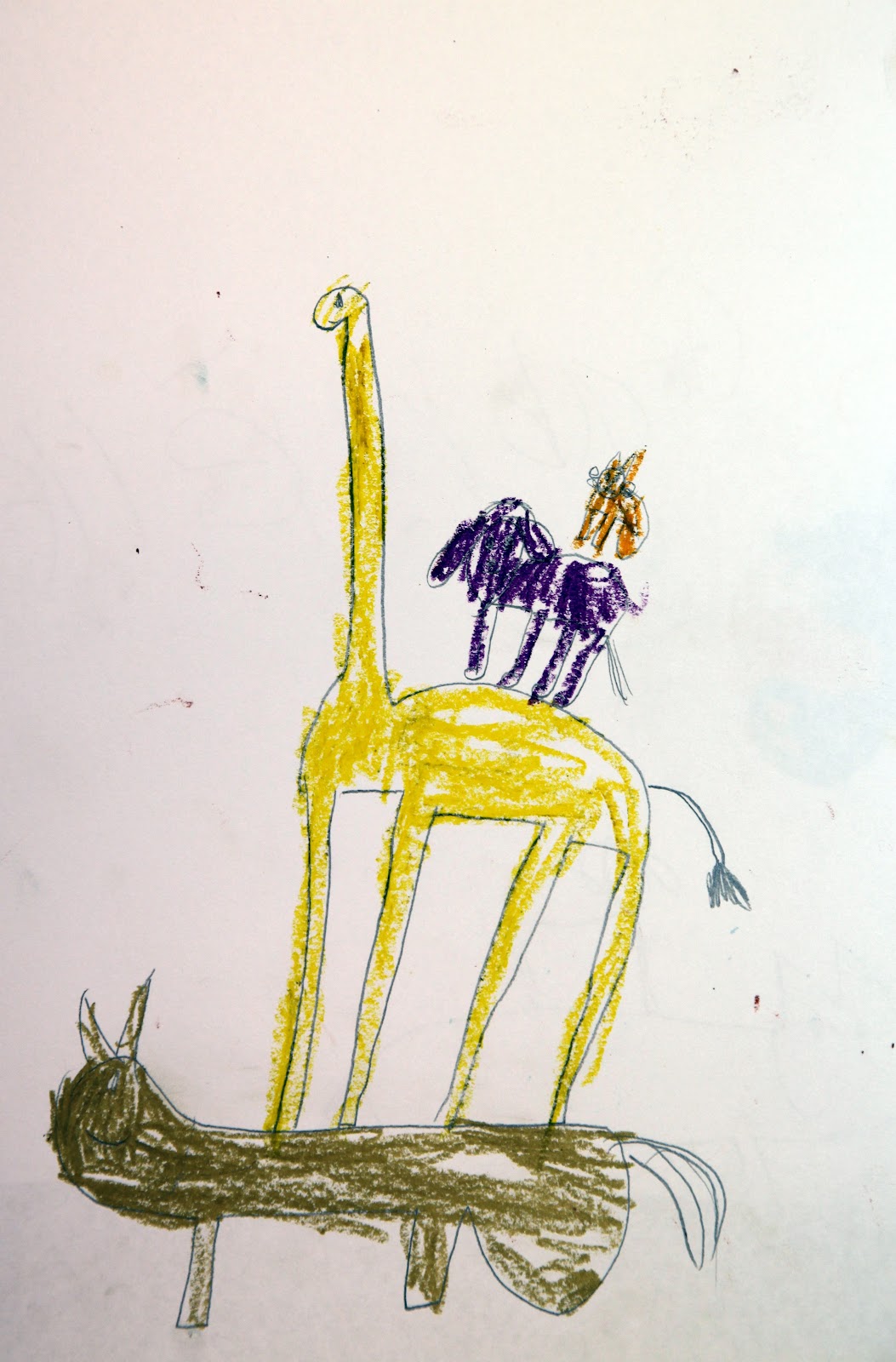
So we drew our own animal stack, trying to position and draw our animals so that our work used up the whole page. We talked about our animal shapes and discussed the similarities in some animals and their special features.


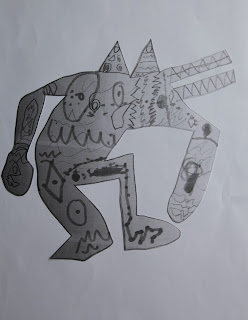
This week Mrs Hiskens surprised us all with a special project influenced by the work of Keith Haring. We are now going to use what we have learnt about our animal shapes and lines to design our own plushie!
Here is the work of Keith Haring that we looked at.


We loved how he used outline to draw simple forms and how he has used lines to create patterns and show movement.
Here are some of our plans for our Keith Haring inspired plushies. Mrs Hiskens photocopied our work and then cut them out to use as templates on our fabric.



Keep an eye on this space so see our finished work.
We began with reviewing what we knew about lines, drawings as many different lines and then painting the areas in and around our lines. Check the flip book Mrs Hiskens made of our line paintings. Here is the link to view it in full http://snack.to/fz9f2c9t
Below is a sneak peek
We then progressed into exploring the contour lines (outlines) of objects and how they helped us see the shape of the object. In this case we used toy animals as our objects. We tried tracing them and drawing them from just looking at them. Mrs Hiskens then told us a funny story about some crazy farm animals.
 |
| Can you guess the story? |



This week Mrs Hiskens surprised us all with a special project influenced by the work of Keith Haring. We are now going to use what we have learnt about our animal shapes and lines to design our own plushie!
Here is the work of Keith Haring that we looked at.

 |
| This one reminded us of a maze, Aboriginal paintings and an x- ray |


We loved how he used outline to draw simple forms and how he has used lines to create patterns and show movement.
Here are some of our plans for our Keith Haring inspired plushies. Mrs Hiskens photocopied our work and then cut them out to use as templates on our fabric.


Keep an eye on this space so see our finished work.
Subscribe to:
Posts (Atom)